Vineyard Wildfire Assessments
Vineyard Wildfire Risk Assessment For Contra Costa, Napa & Solano Counties
Protect your vines, your vintage, and your estate from wildfire with a detailed risk assessment and clear follow up actions.
$1M
Liability Insurance
4
Verified Certifications
3
counties served
Who is this for
Vineyard Wildfire Risk Assessment For Wine Country Operations Of Every Size
Estate owners, vineyard managers, and hospitality operators across Napa, Solano and Contra Costa counties. Whether you’re farming five acres or five hundred, on flat valley floor or steep hillside blocks we assess the specific ways fire threatens your operation and your vintage.
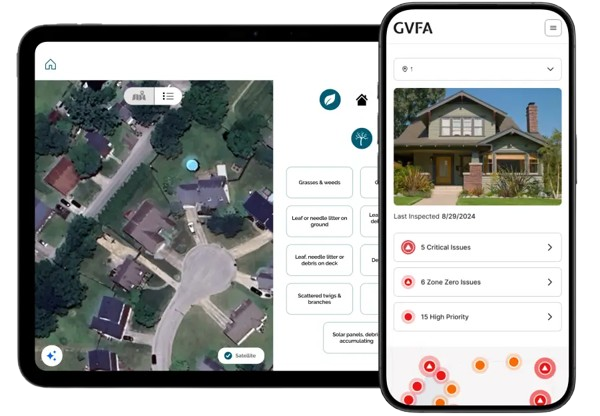
Every assessment is delivered online in partnership with Fire Aside
What You Receive
Actionable Visual & Fully Interactive Vineyard Wildfire Risk Assessment Report
Every vineyard risk assessment is delivered as a online interactive report you can share in one click.
- Annotated site maps of vegetation and structures
- Full photo documentation with GPS tags
- Recommendations ranked by cost and impact
- Insurance-ready documentation format
- One-page action summary for your vineyard manager
why choose red lion wildfire defense
Certified Wildfire Mitigation Specialists Serving Napa, Solano & Contra Costa
Wildfire defense is safety critical work, and clients deserve to know exactly who is walking their property. We hold active accreditations across arboriculture, wildland fire behaviour, and community fire protection standards. We show them before we consult, not after.
ISA Certified Arborist
Certified in tree biology, health, and fire risk. Essential for evaluating canopy fuel loads and defensible tree spacing.
Certified Wildfire Mitigation Specialist
Verifies advanced knowledge in wildland fire science, home hardening, Home ignition zone, defensible space and community-wide planning within the Wildland-Urban Interface (WUI).
Cal Fire Timber Operator
California state licensed for commercial fuel reduction, prescribed thinning, and vegetation management across public and private land.
Firefighter 2 Trained
NWCG certified, Fire Forward trained, Good Fire Alliance credentialed, with current 2026 Wildland Firefighter Type 2 status.
What’s At Stake
Vineyard Wildfire Risk Areas
Fire threatens six distinct assets on a working vineyard.
Smoke Taint
Vines can survive fire, but a single smoke event during veraison can render an entire vintage unsellable.
Hillside Blocks & Canopy Fuel
Slope, wind, and dry summer canopies create fast-moving ground fire that irrigation alone won’t stop.
Equipment & Outbuildings
Tractor sheds and barns are often the first structures lost — and rarely fully insured for replacement.
Tasting Rooms & Hospitality
Public-facing buildings carry strict re-open requirements after damage. Downtime here compounds fast.
Barrel Rooms & Wine Inventory
Barrels, bottled stock, and cased goods represent years of margin sitting in one vulnerable building.
Workforce & Evacuation
Harvest crews on-site during peak fire season need clear, tested evacuation routes — not assumptions.
Our Process
4 Steps From First Call To Interactive Report
01
Consultation Call
A free 30 minute call to understand your Vineyard, included property, scope, and timeline.
02
Site Assessment
A certified specialist walks the property, typically 3 to 6 hours on-site.
03
Interactive Report
You receive a full report with maps, photos, and prioritized recommendations within 10 business days.
04
Review Meeting
We walk you through findings and help you sequence the work for qualified and licensed contractors in the area.
faq
Common Questions From Vineyard Owners & Managers
How does wildfire smoke affect wine grapes?
Wildfire smoke exposes grapes to volatile phenols that bind to grape skins and pulp during and after a smoke event, releasing during fermentation as smoke taint — ashy, medicinal, or bacon-like flavors that can render a vintage unsellable at commercial quality levels. Grape vulnerability peaks between veraison and harvest when berries are actively ripening, and even a few hours of exposure can be enough. Testing for guaiacol and 4-methylguaiacol before harvest is the standard way vineyards in Napa, Sonoma, and Lake County decide whether to pick, bulk out, or walk away from a block.
Will a vineyard wildfire risk assessment help with insurance renewal?
California vineyard insurance carriers increasingly require third-party wildfire documentation as a renewal condition, especially for estates in Very High Fire Hazard Severity Zones across Napa, Solano, and Contra Costa. Our reports are formatted to support three specific situations: policy renewal, non-renewal appeals, and commercial FAIR Plan applications. Vineyard estates combining residential, tasting room, and production buildings often fall under commercial policies where documented mitigation carries measurable weight.
How should vineyard owners prepare for wildfire season in California?
Vineyard owners should complete six steps before California fire season (May through October): commission a professional wildfire risk assessment, verify defensible space compliance across every block and structure, upgrade ember-vulnerable points on tasting rooms, barrel storage, and outbuildings, test water infrastructure including pond drafting capacity and hydrant access, update harvest crew evacuation plans with tested routes, and document all mitigation for insurance renewal. Starting in late winter leaves time to complete work before peak fire weather.
When is the best time to assess a vineyard for wildfire risk?
Late winter through spring, roughly February through May, is the optimal assessment window for three reasons: vegetation is at full growth so seasonal fuel loads are visible, mitigation work can be scheduled and completed before fire season begins in July, and insurance renewal cycles typically land in spring with documented mitigation ready in time. Assessments during peak fire season (July through October) are still useful for immediate documentation but leave less time to complete recommended work.
Can vineyards act as fire breaks?
Green, well-irrigated vineyards can slow surface fire spread and produce fewer embers than open grassland or brush under low to moderate fire conditions. Under extreme wind-driven fire, vineyards do not stop ember cast that carries fire hundreds of yards ahead of the flame front, the 2020 Glass Fire and 2020 LNU Lightning Complex in Napa County both demonstrated this clearly. Vineyards should be treated as one element in a broader defensible space strategy, not as a substitute for structural hardening around winery buildings.
What is the difference between vineyard defensible space and residential defensible space?
Residential defensible space follows California Public Resources Code 4291, requiring 100 feet of managed vegetation around structures. Vineyard defensible space extends that framework by treating the vineyard itself as a distinct fuel type with different fire behavior than grassland or chaparral. Vineyard-specific assessments evaluate row orientation relative to prevailing winds, canopy fuel loads through the growing season, irrigation infrastructure, Type-3 engine access, and outbuilding proximity to vineyard blocks. Cal Fire Chapter 7A building standards apply equally to vineyard residential and hospitality structures.
Are hillside vineyards at higher wildfire risk than valley floor vineyards?
Yes, significantly. Hillside blocks on Atlas Peak, Mount Veeder, Spring Mountain, Howell Mountain, and Pritchard Hill face greater wildfire exposure than valley floor plantings for three reasons: slope accelerates fire spread uphill, ridgelines concentrate wind-driven ember cast, and access for Cal Fire LNU and local district equipment is more constrained. Hillside estates often need additional water storage, pre-planned engine turnarounds, and vegetation treatment on steep ground that valley-floor properties do not require.
Can you assess a property mid-growing-season, or should we wait until after harvest?
Either works. Mid-season shows us real canopy conditions and active operations; post-harvest gives us cleaner access. We can also do the initial walk mid-season and the review meeting after crush.
How long does the assessment take on-site?
A vineyard wildfire risk assessment typically takes 3 to 6 hours on-site, depending on acreage, number of structures, and terrain. A single-block estate in the Carneros or Suisun Valley AVA completes faster, while a multi-block hillside estate on Mount Veeder or Howell Mountain with tasting rooms, barrel storage, and outbuildings may need a second visit. Properties over 100 acres are usually split across two days.
Do you work with existing vineyard management teams and consulting winemakers?
Your vineyard manager knows the land better than anyone, and their input shapes the assessment significantly and we interview them as part of the site visit. Where consulting winemakers, estate directors, or farming companies are involved, we loop them into the review meeting so recommendations align with existing farming calendars, harvest timing, and barrel room operations rather than cutting across them.
Do you coordinate with Cal Fire and local fire districts for vineyard assessments?
We work with Cal Fire LNU (Napa and Solano counties), Cal Fire Sonoma-Lake-Napa Unit, and local districts including Napa County Fire, Solano County Fire, Contra Costa County Fire Protection District, and city fire departments. For larger estates we loop in the local district so responders have pre-plans, gate codes, and access notes on file before an incident. Our reports align with their defensible space guidance and Cal Fire Chapter 7A standards.
How often should a vineyard be reassessed for wildfire risk?
Most vineyard estates in Napa, Solano, and Contra Costa benefit from reassessment every one to two years, or sooner after significant changes to blocks, outbuildings, adjacent land use, or insurance carrier requirements. Vineyards change faster than residential properties — replanting, new tasting rooms, expanded barrel storage, and neighboring parcel changes all shift the risk profile. California’s updated Fire Hazard Severity Zone maps and tightening vineyard insurance terms are additional triggers for an updated assessment ahead of renewal.
We know Vineyards
We Know Vineyards
Vineyards aren’t houses. We assess canopy management as fuel, not just landscape. We look at how prevailing winds move through your rows, where embers will land on barn roofs, whether your pond can actually be drafted by a Type-3 engine, and how your harvest crew gets out if the road above the estate closes. Generic wildfire assessments miss all of this ours is designed around it.
Schedule Consultation Call
Schedule Vineyard Wildfire Risk Assessment Consultation
Free 30 minute consultation call. We’ll tell you honestly whether a full assessment fits your vineyard.